The difference between AI-generated art and AI-assisted creativity—and why that distinction matters.
By Dee Stiff | The Vegas Room Live
Lately, I’ve seen a growing number of arguments on social media about artificial intelligence in music and art. A concert flyer gets posted, someone spots what they believe is AI, and suddenly the discussion isn’t about the show. It’s about whether the person who made the flyer is a “real” artist.
I understand why AI makes people uncomfortable. But I also think we’re failing to distinguish between AI generating the creative work and AI assisting the person creating it.
My perspective comes from spending more than 40 years in technology and roughly the same amount of time as a musician and artist. I’ve watched the tools in both fields change dramatically, and I’ve learned that a new tool doesn’t automatically replace the imagination behind the work.
Before going any further, I want to be clear: I do not rely on AI to create my music or the original artwork I produce for my projects. I develop my own ideas, write and perform my music, and make my own artistic decisions. What I may use are AI-assisted tools that make repetitive technical tasks more efficient.
And yes, I’ll admit that occasionally I enjoy playing around with AI-generated images purely for personal entertainment. I’ve even had some fun turning a picture of our guitarist Vlad wearing armor into “Vlad the Impaler.” Sometimes it’s just entertaining to see what the technology can do.
But there’s a big difference between having a little fun with AI and relying on it to create the music or artwork that represents me as an artist.
To me, that’s an important difference.
Music Is More Than a Song
I’ll be direct about where I stand: I’m against AI-generated music.
Music is more than notes arranged into a melody or words arranged into lyrics. It’s a feeling, a message, and sometimes an escape from the reality of the world around us. At other times, it’s the way we confront that reality.
A song can express grief, anger, love, hope, or frustration when ordinary conversation can’t. It can transport us to a moment we thought we’d forgotten or help us through a moment we’d rather forget.
As a musician, that human experience matters to me. When I write a song or pick up my guitar, I’m expressing something of myself. The imperfections, the choices, the energy of the performance—those are part of its identity.
I know an AI-generated song can sound polished and even move a listener emotionally. I’m not denying that someone might connect with what they hear. But the system generating it hasn’t experienced the heartbreak, excitement, or struggle that the music claims to express.
For me, that’s a fundamental difference. I don’t want a machine replacing the human story behind the music.
But that doesn’t mean I reject AI-assisted recording and mixing tools.
Anyone who has spent serious time in a recording studio knows how many hours can disappear into editing, cleaning up unwanted noise, isolating problem frequencies, or repeating the same adjustments across multiple tracks. Those tasks are necessary, but they’re not why most of us fell in love with making music.
We’ve long used track templates, presets, macros, and automation to speed up that work. AI-assisted tools can take some of those efficiencies further. If software helps me clean up a recording in minutes instead of hours, the song is still mine. I still wrote it, performed it, and decided how it should sound.
I’m against AI replacing the musician. I’m not against technology helping the musician.
The Same Distinction Applies to Graphic Art
The argument becomes especially visible when someone posts a flyer or promotional graphic. People often judge the entire work by whether they think AI was involved, without asking how it was used.
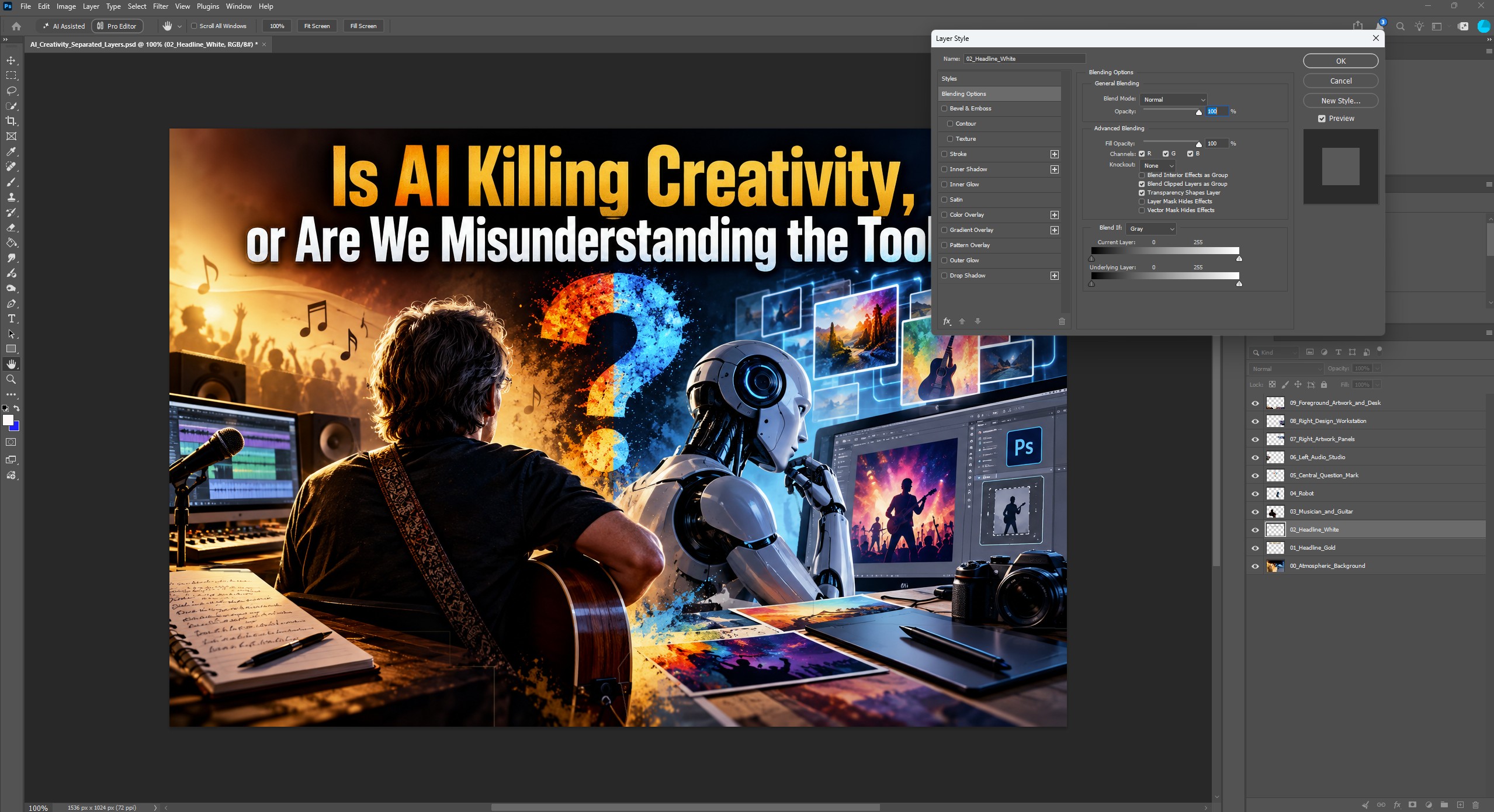
Consider Photoshop. Graphic artists have relied on actions, filters, presets, and automated processes for years. Now Photoshop also includes AI-assisted features that can help select subjects, remove distractions, or simplify difficult editing work.
Here’s the irony. Much of the digital artwork people admire online may already involve AI-assisted tools. Yet some of the people criticizing those tools have never used the applications themselves and may not understand how artists actually work with them.
Some generative features can create entirely new image content, which raises a different set of questions. But using an intelligent selection tool is not the same thing as asking a generator to invent a complete concert poster.
I don’t use AI to come up with my artistic vision. The composition, concept, message, and final judgment are mine. If a tool makes it faster to isolate a subject or remove an unwanted element, I see that as an improvement to the workflow, not a substitute for creativity.
A person can know every Photoshop command and still struggle to design something compelling. Likewise, a musician can master every function of a recording program and still struggle to write a song that connects with anyone.
Knowing how to operate the tools isn’t the same as having something to say.
We’ve Seen Creative Technology Change Before
Those of us who have worked through several generations of technology have seen versions of this debate before.
Digital recording challenged analog methods. Computer-based production changed what musicians could accomplish without a major studio. Digital photography and editing software transformed graphic design.
And long before today’s AI tools, we were building macros to repeat complicated tasks and saving presets so we didn’t have to start from scratch every time.
We didn’t lose ownership of our ideas because we stopped adjusting every control manually. We gained time to focus on the decisions that mattered.
AI is not identical to a macro or a preset. Some systems can generate work on their own, and that creates new problems. But when AI is used to assist with a technical task under an artist’s direction, the goal of efficiency is familiar.
That is the distinction I wish more people would recognize before deciding that every use of AI is somehow cheating.
The Concerns Are Real
None of this means AI should get a free pass.
Training systems on artists’ work without permission, imitating a musician’s voice, and distributing synthetic music without transparency raise legitimate questions about consent, ownership, compensation, and authenticity. There are also real concerns about people losing work as businesses choose automated content over human creators.
Those issues deserve serious attention, not dismissal.
But the criticism becomes less useful when we treat a noise-removal feature in a recording program as though it’s equivalent to generating an entire song, or an AI-assisted selection in Photoshop as though it’s equivalent to replacing a graphic artist.
Rather than stopping at “Was AI used?”, I’d rather ask: What did the technology actually do, and who made the creative decisions?
The Person Behind the Work Still Matters
After four decades in both technology and music, I’m not interested in abandoning the creative process that brought me here.
I want to write songs, play guitar, shape recordings, and create artwork that reflects my own ideas. I believe music should carry the feelings and experiences of the people making it. That’s why I oppose AI-generated music.
I also want to spend more of my time creating and less of it repeating technical procedures that software can handle.
Those positions aren’t contradictory. They reflect a simple principle: Use technology to support the artist, not to replace the artist.
The tools will keep changing. Our responsibility is to decide what we allow them to do, and what should remain human.
So here’s the question I’d leave you with:
If an artist provides the vision, the performance, and the creative decisions, does using an AI-assisted tool for repetitive tasks make the work any less authentic?
Or are we becoming so focused on the tool that we’ve stopped looking at the person behind it?